Intro • Start here
Use notes freely — they save on this device.
Welcome to MENTRA Self-Learning Training
This self-learning training is a complementary digital output of the PeerMent project.
It is based on the MENTRA training programme and translates the core workshop-based content into an
independent learning experience for VET practitioners, mentors, trainers, and professionals working with
mentoring in the Creative and Cultural Industries (CCI).
The goal is practical competence: clarity of roles, effective communication, reflective practice, ethical and inclusive mentoring,
and confident use of digital tools. You can work at your own pace — pause, return, and reuse this as a reference.
Quick Check-In
Write a short “starting statement”:
- What mentoring context are you currently in (or preparing for)?
- What would you like to improve most as a mentor?
Intro • How this training works
Structure
How to Use This Training
MENTRA is structured into six modules. Each module includes a short overview, core concepts,
practical exercises, and a wrap-up micro-action you can apply immediately in your mentoring practice.
- Read the key ideas and examples.
- Do the exercises using the note fields (or your own notebook).
- Apply one micro-action in real mentoring situations.
- Reflect and refine — mentoring competence develops through iteration.
Suggested pacing
For a realistic VET rhythm, plan 1 module per week (or per mentoring cycle).
If you are training a group, you can also use these pages as guided prompts during workshops.
Your learning plan
Choose your approach:
- My pace (e.g., weekly / intensive / on-demand):
- My application context (real mentoring / preparing to mentor / training others):
Intro • Outcomes
Competence focus
What You Will Be Able to Do
By the end of this self-learning training, you should be able to:
- Define mentoring roles, responsibilities, and boundaries in CCI contexts.
- Design a mentoring relationship: goals, expectations, structure, and trust-building.
- Use core mentoring communication skills (active listening, questioning, feedback, coaching stance).
- Apply reflective practice and perspective-taking to improve mentoring quality.
- Use practical mentoring tools and digital methods to support the process.
- Work ethically and inclusively; manage power, confidentiality, and safeguarding.
- Support professional development and future pathways beyond immediate challenges.
Personal priorities
Select the top 2 outcomes that matter most for your current work. Why those two?
Module 1 • Overview
Foundations
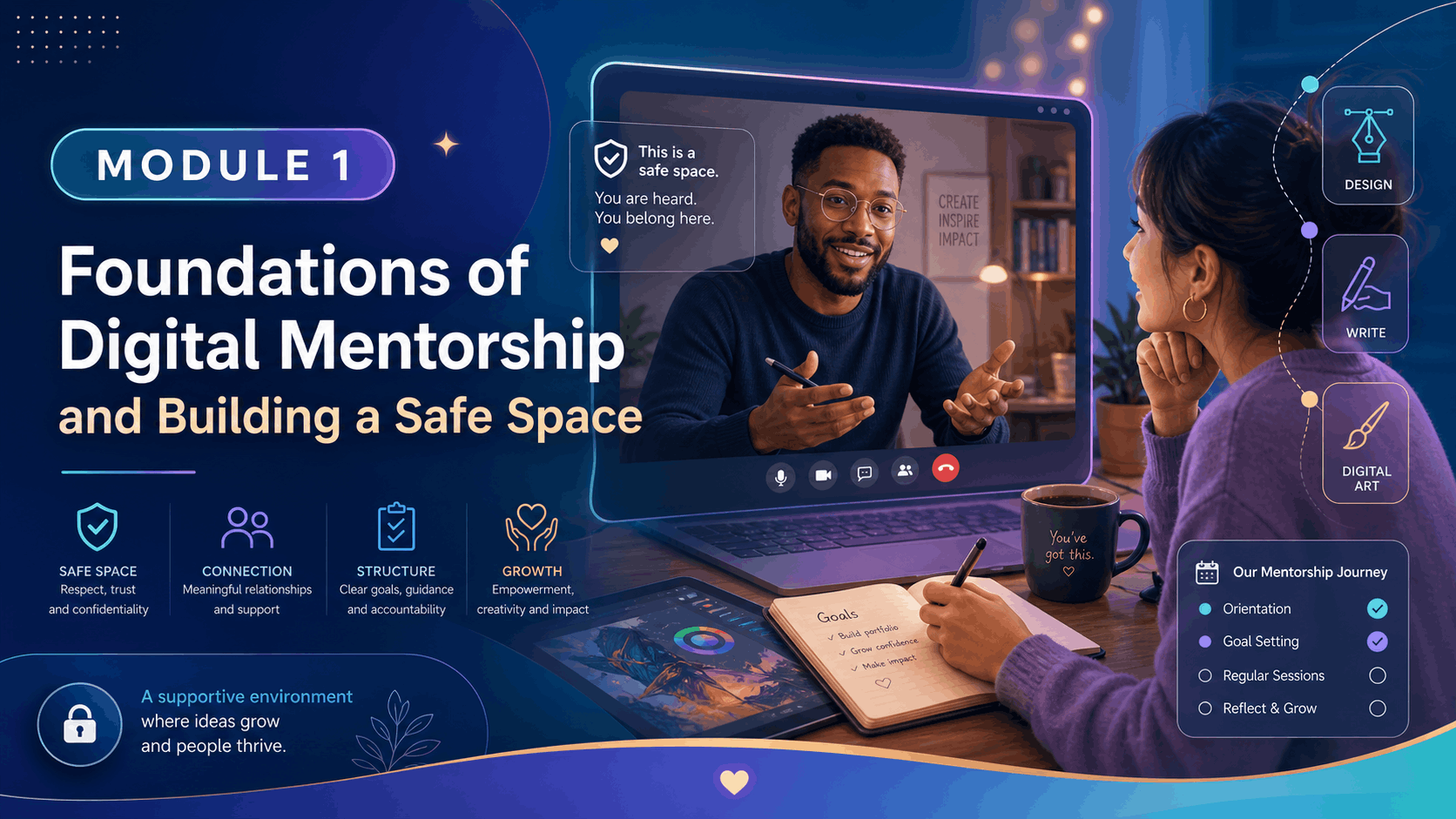
Module 1: Mentoring Foundations and Roles
Mentoring is a professional practice that requires clarity, intention, and responsibility.
In the Creative and Cultural Industries, mentoring often starts informally — but high-quality mentoring depends on
making roles, expectations, and boundaries explicit.
Learning focus: What mentoring is (and is not), mentor/mentee roles, and the foundations of a safe, useful relationship.
MENTRA principle
Mentoring is not “giving answers”. It is structured support that helps the mentee develop agency, make informed decisions,
and grow professionally.
Start here: your mentoring definition
In 3–5 lines, write your own definition of mentoring in your context.
Module 1 • Core concepts
Roles, boundaries, scope
Roles, Responsibilities, and Boundaries
A mentoring relationship is stronger when both sides understand what they are responsible for.
In VET and professional mentoring contexts, unclear boundaries can create dependency, frustration, or ethical risk.
- Mentor: provides structure, questions, feedback, and professional perspective; supports learning and decision-making.
- Mentee: brings goals, openness, and ownership; takes action between sessions; reflects and applies learning.
- Scope: define what the mentoring covers (and does not cover), including limits of expertise and time.
+
Mentoring vs. coaching vs. consulting
- Mentoring: guidance + development, based on experience and relationship.
- Coaching: goal-focused performance and mindset work (often method-driven).
- Consulting: expert recommendations and solutions for a defined problem.
In real practice, these can overlap — the key is to be transparent about which “hat” you are wearing.
Boundary check
Where do boundaries get blurry in your context (friendship, hierarchy, emotional support, business advice, etc.)?
Module 1 • Practice
Agreement + expectations
Exercise: Set a Mentoring Agreement
A mentoring agreement does not need to be bureaucratic. It is a practical tool to align expectations and reduce risk.
In CCI contexts (often freelance and project-based), alignment is especially important.
Draft your “minimum agreement”
Write a short agreement outline (bullet points are fine):
- Purpose and goals of mentoring
- Roles and responsibilities (mentor / mentee)
- Session rhythm (frequency, duration, format)
- Confidentiality and data handling
- Boundaries (what is out of scope)
- How feedback and follow-up will work
VET delivery tip
If you are training mentors, ask participants to compare two agreement drafts: one “too vague” and one “clear”.
Discuss how clarity affects trust and accountability.
Module 1 • Wrap-up
Micro-action
Module 1 Wrap-Up: Clarity as a Quality Standard
High-quality mentoring starts with clear foundations: roles, scope, expectations, and boundaries.
This protects both mentor and mentee, and it creates a professional learning space.
Self-assessment
Rate yourself (1–5) and write one improvement step:
- I can clearly explain what mentoring is in my context. (1–5)
- I can set boundaries respectfully and consistently. (1–5)
- I can co-create a simple mentoring agreement. (1–5)
Micro-action (this week)
Choose one real improvement you will implement immediately (even in an informal mentoring relationship).
- Example: “I will start the next session by confirming goals and boundaries in 3 minutes.”
Continue to Module 2 to focus on core mentoring skills and communication quality.
Module 2 • Overview
Communication in practice
Module 2: Core Mentoring Skills and Communication
Mentoring quality depends not only on clarity of roles and boundaries, but also on how mentors communicate in practice.
Communication is the main “tool” of mentoring: listening, asking, reframing, and giving feedback in ways that support growth.
Learning focus: active listening, powerful questions, feedback, and supportive communication in CCI mentoring contexts.
Baseline: your mentoring style
Which tendency is most like you today (choose one and explain):
- I often “solve” too quickly.
- I listen but struggle to challenge.
- I give feedback but it sometimes lands defensively.
- I am structured, but conversations can feel rigid.
Module 2 • Core concepts
Listening + questioning
Active Listening and Powerful Questions
Active listening is not passive. It is a disciplined practice of attention: understanding content, emotions, assumptions,
and what remains unsaid. In CCI mentoring, mentees may carry uncertainty, identity questions, and unstable career conditions —
listening helps surface what really matters.
Listening checklist
- Listen for facts and feelings.
- Reflect back key points (“What I hear is…”).
- Test assumptions (“When you say ‘not possible’, what constraints do you mean?”).
- Summarise and confirm before advising.
+
Question types you can use immediately
- Clarifying: “What exactly is the decision you need to make?”
- Exploring: “What options have you not considered yet?”
- Prioritising: “What matters most in the next 2 weeks?”
- Reality-checking: “What evidence supports that fear?”
- Agency-building: “What is one step you control today?”
Practice prompt
Write 6 questions you can reuse in your mentoring sessions (mix different question types).
Module 2 • Practice
Feedback + support
Giving Feedback that Supports Growth
Feedback in mentoring should strengthen learning and responsibility — not dependency.
The key is to make feedback specific, respectful, and connected to the mentee’s goals.
A simple feedback structure
- Observation: What you noticed (concrete and factual).
- Impact: What it caused (results, risks, feelings).
- Question: Invite reflection (“How do you see it?”).
- Option: Offer a choice or suggestion (not an order).
Exercise: Rewrite feedback
Take a “too harsh” or “too vague” feedback you’ve used before. Rewrite it using the structure above.
Support vs. rescue
Where do you risk “rescuing” a mentee (taking over responsibility)? What boundary statement could you use instead?
Module 2 • Wrap-up
Micro-action
Module 2 Wrap-Up: Communication as Competence
In mentoring, communication is not “soft”. It is a professional skill set: listening, questioning, feedback,
and emotional regulation. These skills are trainable — and they directly determine mentoring outcomes.
Self-check
Complete the prompts:
- The communication habit I want to improve is…
- I will know it is improving when…
- The most useful question I wrote today is… because…
Micro-action (next session)
Pick one micro-action and commit:
- Use a 2-minute summary at the end of the session.
- Ask 3 questions before giving any advice.
- Use the feedback structure once on a real example.
Continue to Module 3 to train perspective-taking through mentorship swap and reflective practice.
Module 3 • Overview
Perspective + reflection
Module 3: Mentorship Swap and Reflective Practice
Mentoring is shaped not only by skills and methods, but also by perspective.
How mentors understand the mentee experience influences how they listen, how they challenge, and how they design support.
Learning focus: role reversal (“mentorship swap”), reflective practice, and improving mentoring through structured reflection.
Recall a mentoring moment
Describe one mentoring situation that felt difficult or “stuck”. What made it hard?
Module 3 • Tool
Mentorship swap
Mentorship Swap: See Through the Mentee’s Eyes
A mentorship swap is a structured exercise where you analyse the mentoring relationship from the opposite role.
This helps you identify blind spots: power dynamics, assumptions, unmet needs, and unclear communication.
Swap exercise
Take your “stuck moment” and answer as if you were the mentee:
- What did I (the mentee) need in that moment?
- What did I understand from the mentor’s words and tone?
- What felt supportive, and what felt discouraging?
- What action did I leave with (or not leave with)?
Quality signal
When mentees leave sessions without a clear next step, motivation and trust typically decline.
Even a small “next action” increases accountability and momentum.
Module 3 • Practice
Reflective cycle
Reflective Practice Cycle for Mentors
Reflective practice turns experience into competence. A simple cycle is:
Describe → Interpret → Decide → Apply.
Apply the cycle
- Describe: What happened (facts)?
- Interpret: What might it mean (needs, assumptions, dynamics)?
- Decide: What is one improvement you will try?
- Apply: When and how will you test it?
+
Reflection prompts you can reuse after every session
- What did the mentee do well today (strengths)?
- What did I do well today (mentor strengths)?
- Where did I feel tension, uncertainty, or impatience — and why?
- What is the clearest next step for the mentee?
Module 3 • Wrap-up
Micro-action
Module 3 Wrap-Up: Improve Through Perspective
Perspective-taking reduces misunderstandings and strengthens mentoring relationships.
Combined with a simple reflective cycle, it becomes a repeatable quality assurance practice for mentors.
What changed?
After the swap, what new insight did you gain about the mentee’s experience?
Micro-action (after every session)
Commit to a 5-minute reflection routine after the next 3 sessions. Write your plan:
Continue to Module 4 to explore mentoring realities and needs in the Creative and Cultural Industries.
Module 4 • Overview
CCI realities
Module 4: Mentoring in the Creative and Cultural Industries
Mentoring in the CCI takes place in contexts that are often uncertain, fragmented, and non-linear.
Careers frequently involve freelance work, portfolio-based income, project cycles, and evolving professional identities.
Learning focus: adapting mentoring approaches to CCI realities; supporting resilience, decision-making, and sustainable career pathways.
Map your CCI context
What are the most common challenges your mentees face (choose 3–5)?
- Income instability / pricing
- Portfolio development / visibility
- Networking / access to opportunities
- Confidence / impostor feelings
- Time management / overload
- Project planning / client relations
- Legal/contract basics
Module 4 • Core concepts
Non-linear careers
Non-Linear Pathways and Professional Identity
In CCI, professional identity often evolves through experimentation: new roles, collaborations, client types, and skill development.
Mentoring can support mentees in clarifying direction without forcing a single “correct” path.
Mentor stance in CCI
- Support decision-making under uncertainty.
- Help mentees turn experience into strategy (what worked, what didn’t, why).
- Focus on transferable skills: communication, planning, negotiation, reflection.
- Balance ambition with sustainability (workload, wellbeing, boundaries).
Identity question
What “identity tension” do you see most often (e.g., artist vs. entrepreneur, creative freedom vs. client demands)?
Module 4 • Practice
Case-based mentoring
Exercise: Case-Based Mentoring in CCI
CCI mentoring becomes practical when it connects to real situations: a client conflict, portfolio decisions, pricing, project planning,
or creative direction. Case-based mentoring helps mentors structure support without “taking over”.
Choose a typical case
Write one realistic mentee case (or use a real one anonymously):
- Situation (what is happening)
- Decision needed (what must be decided)
- Constraints (time, money, skills, environment)
- Risks (what could go wrong)
- Support needs (what mentoring can help with)
Mentor questions
Write 5 mentor questions that build agency (not dependency) for this case.
Module 4 • Wrap-up
Micro-action
Module 4 Wrap-Up: Mentoring for Real-World CCI Needs
Effective CCI mentoring is contextual: it respects uncertainty, supports sustainable professional choices, and turns real challenges
into learning and strategy.
What will you change?
What is one adjustment you will make to better fit CCI realities (structure, examples, tools, boundaries, etc.)?
Micro-action (in your next mentoring cycle)
Commit to one case-based tool:
- Start with “decision needed + constraints” before discussing solutions.
- End with a clear next step and a realistic timeline.
- Use a short “risk scan” (best case / worst case / most likely).
Continue to Module 5 to work with digital mentoring tools and platform-supported mentoring.
Module 5 • Overview
Digital mentoring
Module 5: Digital Mentoring Tools and Platform Use
Digital tools are an integral part of contemporary mentoring practice. In many mentoring relationships,
communication, coordination, and documentation happen online. Done well, digital mentoring increases accessibility,
continuity, and structure — especially in transnational or multi-location contexts.
Learning focus: selecting appropriate tools, structuring online sessions, and supporting mentoring through platform features and documentation.
Your digital reality
List the tools you currently use (or plan to use) for mentoring and what each is for.
Module 5 • Core concepts
Quality + access
What Makes Digital Mentoring High-Quality?
Digital mentoring can fail when it becomes “just messaging” or when sessions lack structure.
High-quality digital mentoring is built on the same foundations as face-to-face mentoring — plus intentional design for the medium.
Digital mentoring quality checklist
- Clear session goals + shared agenda
- Reliable scheduling and timekeeping
- Shared documentation (actions, resources, decisions)
- Appropriate privacy and consent (confidentiality)
- Accessibility (time zones, bandwidth, inclusive formats)
Risk scan
What risks do you see in digital mentoring in your context (privacy, misunderstandings, drop-off, overload)?
Module 5 • Practice
Session design
Exercise: Design a 45–60 Minute Online Mentoring Session
Structure is supportive, not restrictive. A simple session template helps mentors stay focused and helps mentees leave with clarity.
Session template
Draft a reusable session plan:
- Opening (5 min): check-in + confirm focus
- Work phase (30–40 min): explore → clarify → choose
- Action (10 min): define next steps + responsibilities
- Closing (3–5 min): summary + feedback + next date
+
Documentation prompts (copy/paste)
- Today’s focus:
- Key decisions / insights:
- Actions (what, who, by when):
- Resources to review:
- Next session date + agenda draft:
Module 5 • Wrap-up
Micro-action
Module 5 Wrap-Up: Digital Tools as Mentoring Infrastructure
Digital mentoring works best when tools serve the learning process: clarity, continuity, and accountability.
Use platforms and documentation to support (not replace) the relationship.
Tool decision
Choose one tool to improve (or adopt). Define: purpose, rules, and how you will keep it simple.
Micro-action (next online session)
Commit to one structure upgrade:
- Use a shared agenda + end-of-session summary.
- Use the documentation prompts to capture actions.
- Agree on a communication rule (response time, channel, boundaries).
Continue to Module 6 to focus on professional development and future pathways.
Module 6 • Overview
Beyond immediate problems
Module 6: Professional Development and Future Pathways
Mentoring does not end with the resolution of immediate challenges. An important role of mentoring is to support mentees
in developing longer-term professional direction, resilience, and learning pathways — especially in fast-changing CCI environments.
Learning focus: growth planning, competence development, future pathways, and sustainable mentoring outcomes.
Future focus
What do your mentees typically need most help with long-term?
Module 6 • Core concepts
Development planning
From Goals to Pathways
In mentoring, “goals” become meaningful when they connect to a pathway: competencies to develop, experiences to gain,
networks to access, and realistic steps that fit the mentee’s context.
Pathway components
- Direction: what the mentee is moving toward
- Competences: skills and knowledge to develop
- Evidence: portfolio proof, references, outcomes
- Support system: peers, networks, organisations
- Sustainability: workload, wellbeing, financial realism
Mentor contribution
What is your strongest contribution to a mentee’s pathway (knowledge, networks, perspective, accountability)?
Module 6 • Practice
Development plan
Exercise: Create a 3–6 Month Development Plan
A short development plan helps mentees move from “general ambition” to practical progress.
It should be realistic, measurable, and adaptable.
Plan template (mentor-guided)
Draft a plan you can co-create with a mentee:
- Goal (3–6 months): …
- Top 3 competencies to improve: …
- Actions (what, who, by when): …
- Evidence/outputs: portfolio items, projects, applications, collaborations
- Risks/barriers: and mitigation
+
Evidence examples for CCI mentees
- Updated portfolio with 2 curated case studies
- One collaboration or exhibition application
- A pricing sheet + client proposal template
- Documented learning (course completion, reflection, new method tested)
Module 6 • Wrap-up
Completion
Final Wrap-Up: Sustaining Mentoring Impact
Mentoring impact becomes sustainable when mentees leave with agency: clearer direction, stronger competencies,
and tools they can continue using after mentoring ends.
Your quality standard
Complete:
- For me, a “successful mentoring cycle” means…
- The most important mentoring habit I will keep is…
- The mentoring skill I will keep improving is…
Micro-action (next cycle)
Commit to one sustainability step:
- Use a 3–6 month development plan with every mentee.
- Create a simple “resource pack” for mentees (templates, links, rules).
- Introduce a structured closing session (review, evidence, next steps).
You have completed the MENTRA Self-Learning Training. You can revisit any module at any time and treat this as
a living companion to your mentoring practice.